Public sector
Utilities, social housing,
agencies.
Two products born at public operators. Agora gets your staff and your users participating; m2 keeps the register of your property. Each one is installed for you alone, in France, within days.
Where they come from
Designed inside
the public service.
Agora was born from the CAF du Var partner portal and runs at Eau de Paris today. m2 was born in a town hall of 8,000 people. Every screen exists because someone on the staff needed it: partners to register, ideas to assess, decisions to publish with their reasons, property to account for to the council. Nothing was adapted from a generic product.
Three profiles
Who are you?
-
01
Utility
You run a territory's water, energy or transport. Agora gives your staff an ideas platform and your users a participatory budget, with one installation per module.
-
02
Social housing
Your tenants and partners need a front door: an account, news, events, requests that reach the right desk. That is Agora's Portal module.
-
03
Municipality, agency
Your housing, premises and leases in one register, rents computed, deeds generated. That is m2, and we bring your data across on the way.
Built in
What a public operator expects, already there.
-
Staff and user accounts
Sign-in with the work e-mail address, separate administration roles, versioned terms of use and a register of who accepted them.
-
Assessment and reasoned decisions
Every idea or request goes through a department that assesses it, and the decision is published with its reasons. Kept or not, it stays on record.
-
RGAA accessibility
Structure, contrast, keyboard, screen readers: everything is built to the standard, and the statement comes with your installation.
-
An instance of your own
A separate installation for each client, hosted in France. Your content, your accounts, your visual identity.
-
Exports and registers
Everything on screen exports to a spreadsheet, with the same filters. The personal-data processing register is kept for you.
-
Hand-back at the end
You leave with your data, your media and the notes to read them elsewhere. The installation is then erased, with a written record to prove it.
Two products
Agora for participation: portal, ideas and challenges, participatory budget, by module. m2 for property: register, rents, deeds.
-
Agora
The participation platform for public operators.
Your site, your accounts and your staff's or your users' participation, in a single contract, on an installation of your own.
Nutshell product Utilities · social housing · agencies -
m2.immo ↗
m2
Cut the time spent on your property portfolio by three.
Property management software for local authorities: centralised data, automated calculations, compliant deeds.
Nutshell product Municipalities · inter-municipal bodies
Screens
As they run.
Eau de Paris' platforms and a town's register, as they run. Not mock-ups.
-
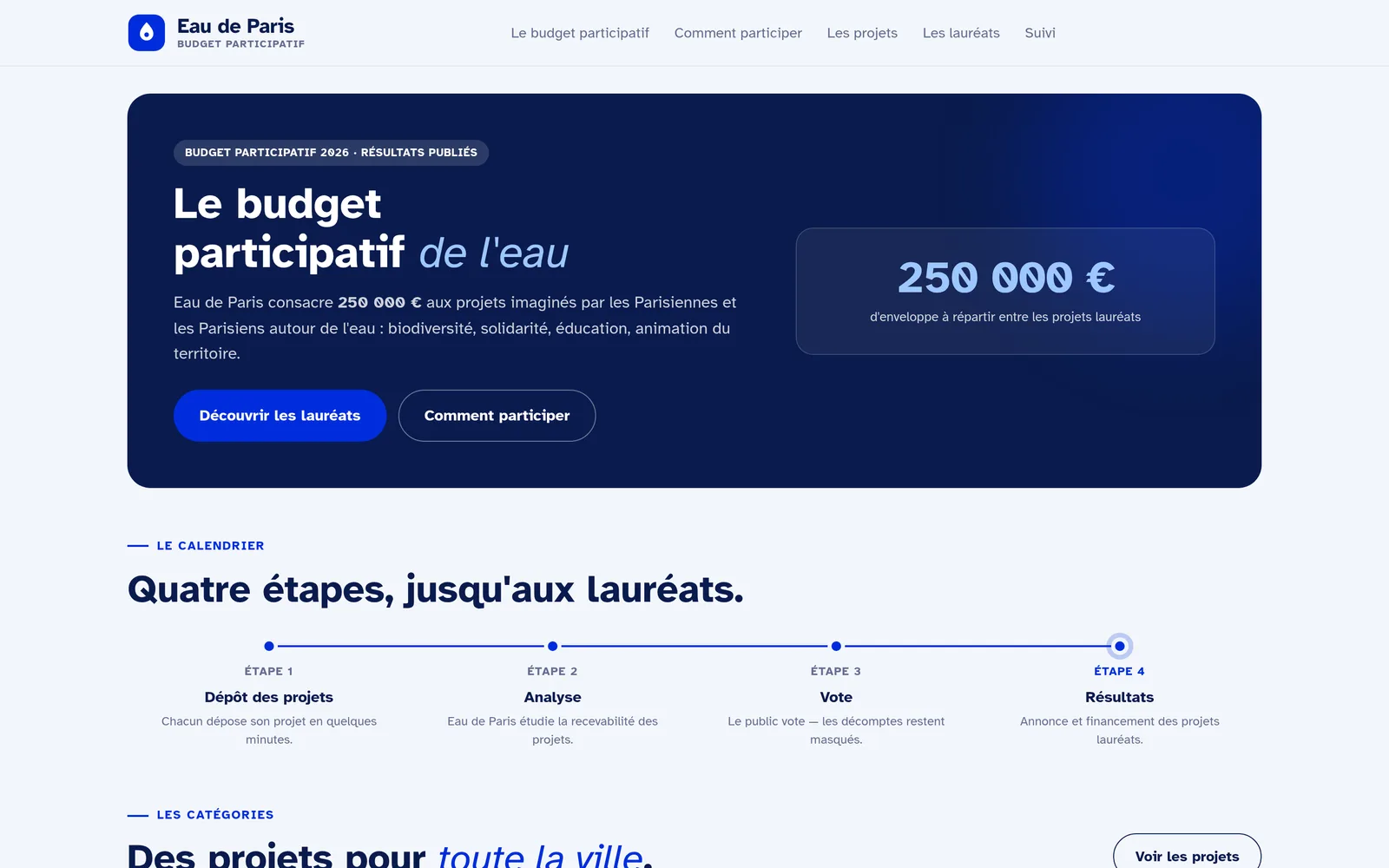
Eau de Paris' participatory budget. -
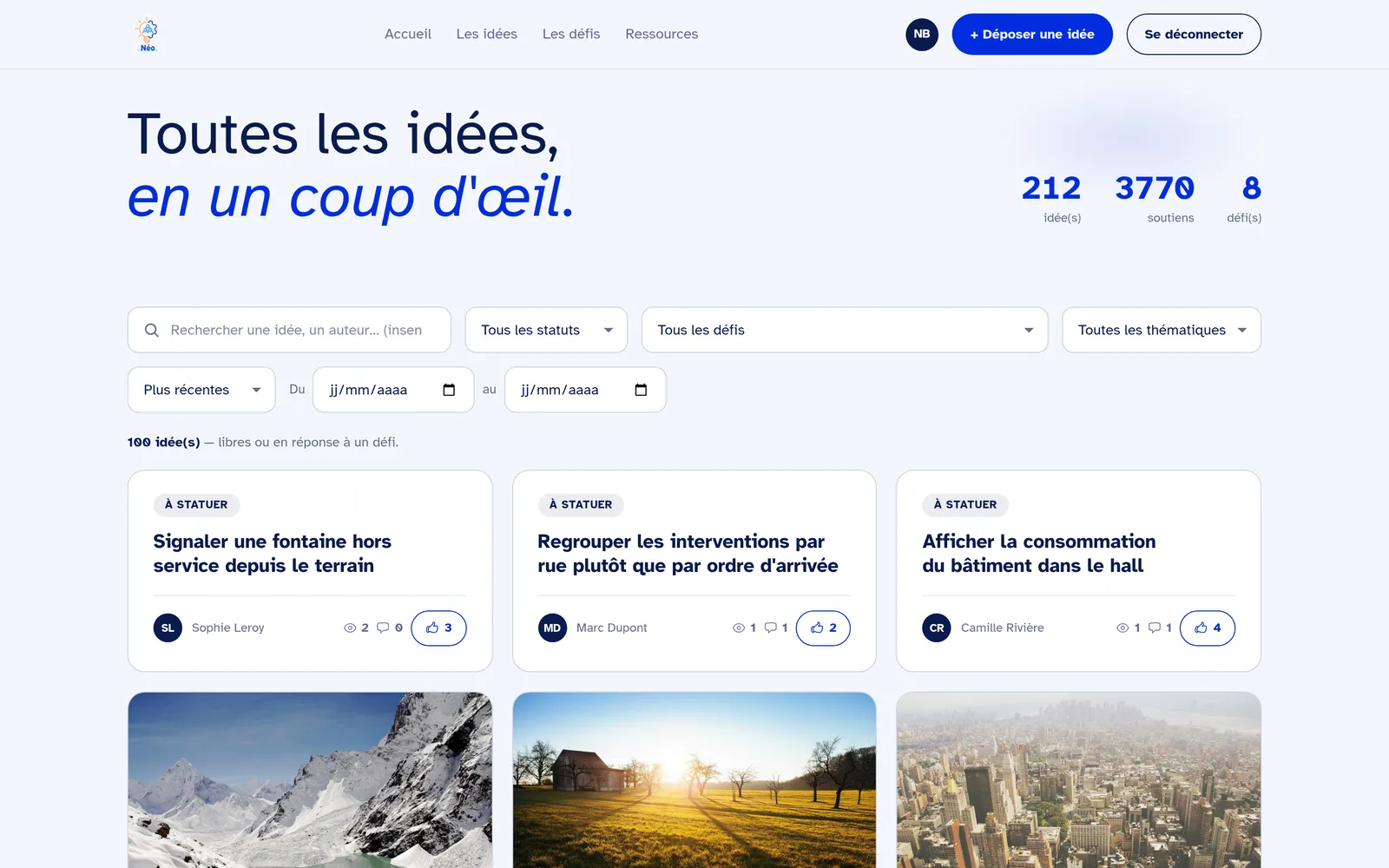
Néo, ideas from Eau de Paris' staff. -
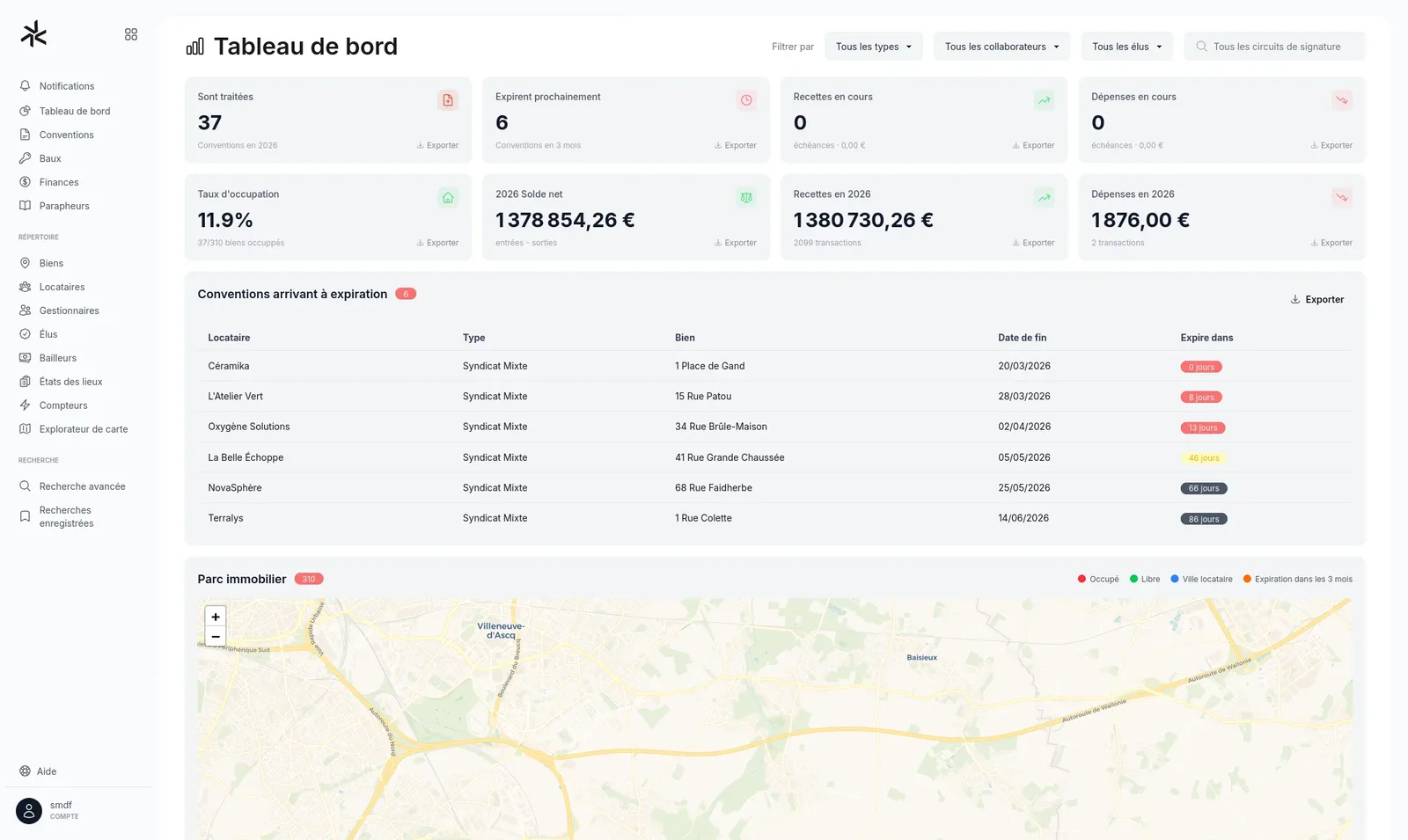
A town's register and rents in m2.
How it goes
Four steps, one point of contact, and nothing to install on your side.
-
01
A request
You write to us: who you are, what you want to open to your staff or your users, and by when. Within a week, you have a scope and a calendar.
-
02
A scoping
Half a day with your departments to settle the modules, the roles, the visual identity and the data to bring across. The submission form and the texts are yours to write.
-
03
An instance of your own
A separate installation, in France, up in days. Your content, your accounts, your domain name.
-
04
The day you leave
If you stop, you get everything back: the data in a standard format, the media, and the notes to read them elsewhere. Nothing stays with us.
What exists today
-
RGAA accessibility
self-assessment under wayThird-party audit and accessibility statement planned for the first quarter of 2027.
-
Data and GDPR
pack being writtenProcessing register, sub-processors, retention periods, erasure: delivered with every instance.
-
Hosting
France · one space per clientData hosted in France, per-client backups, full hand-back: your data, your media and the notes to read them elsewhere.
-
Security
standard questionnaire readyOne isolated instance per client. Hardening and penetration test planned for 2027.
-
AI
models hosted in the EUNo client data is used to train a model; every use is named in the processing register and explainable to an auditor.
Before signing
The questions we get asked.
01 Where is the data, and who can reach it?
On an installation that is yours alone, hosted in France. Nobody reaches it but you and the Lab's team, and every Lab access is named and logged.
02 What happens at the end of the contract?
You get everything back: all of your data in a standard format, your media, and the notes that make them readable elsewhere. The instance is then erased, with a written record.
03 And accessibility?
Both products are built for RGAA: structure, contrast, keyboard, screen readers. Self-assessment is under way; the third-party audit and the accessibility statement are planned for the first quarter of 2027 and delivered with your instance.
04 Can we start with a single module?
Yes. Agora's core is always there; after that you take the modules you need, Portal, Ideas & challenges or Participatory budget. A utility that only wants a participatory budget pays for that alone.
05 How does buying work?
On a quote, for a duration you choose. Our contracts stay under the public-procurement threshold that waives competitive tendering (article R2122-8), which the quote documents for your purchasing department.
Public-sector notes
-
006 · PUBLIC SECTOR
Buying software under €60,000 without a tender
-
007 · ACCESSIBILITY
RGAA: what Arcom fines, and where to start
-
008 · ARCHITECTURE
One instance per client: why we did not build a multi-tenant
-
009 · DATA
Moving data out of spreadsheets without a season of re-keying
-
011 · PUBLIC SECTOR
AI and public procurement: what a buyer can require
References
They trusted us.
-
Public water utility · Paris
Eau de Paris
Néo, where the utility's staff submit and carry their ideas behind the single sign-on, and the participatory budget open to Parisians. Two Agora modules, each on its own installation.
Being deployed · opening January 2027
Read the case → -
Municipality · Val-de-Marne
Saint-Maur-des-Fossés town hall
The town's housing, premises and leases, out of the spreadsheets and into m2, data included.
In production
Read the case → -
Social security fund · Var
CAF du Var
A portal for hundreds of partners: accounts, news, events, directory, requests routed to the right desk. The Lab built it with its earlier tools; it is what Agora's Portal module was specified from.
In production
Read the case →
Public sector · 2026
Ask for
a proposal.
A utility, a social landlord, a town hall: tell us what you want to open, to whom, and by when. You'll have a scope and a calendar within a week, and a proposal right after if it suits you.
hello@nutshell-lab.com